No products in the cart.


ADOLPHE JACQUES BARTHELEMY APPIAN
Lyon 1818 – 1898 Lyon
Adolphe Appian was a painter, engraver, and draftsman active in Lyon in the nineteenth century. He was the student of François Groban and Augustin Thierriat at the Ecole des Beaux-Arts of Lyon. In 1852 he became acquainted with Jean-Baptiste Corot and Charles-François Daubigny. Their paintings and drawings influenced Appian to work more broadly, concentrating on composition and the effects of light and atmosphere in his landscapes. Painting en plein air, he worked in the Pyrenees, Auvergne, Fontainebleau, and Italy. His landscapes were greatly appreciated by his contemporaries. He showed his works every year at the Salons of Lyon and Paris and the galleries Bernheim, Durand-Ruel, and Goupil. He received the Legion d’Honneur in 1892. In 1894, he was elected Président d’Honneur of the Société Lyonnaise des Beaux-Art and received a gold medal at the international exhibition of Lyon.
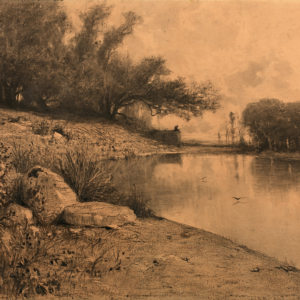
Appian was especially well known for his highly finished drawings in charcoal on toned paper. His drawings were first exhibited at the Salon in Paris in 1853 and he won a gold medal at the Black and White exhibition in 1885 for his drawings Canal and L’Etang de Frignon. Rivers and waterways with mirror like surfaces and large expanses of sky were favorite themes of Appian. In our drawing, a boat is tied up at an embankment on what is probably the Rhône River. It appears to be dusk. The calm but mysterious atmosphere, as well as the technique used here, recalls the drawings in conté crayon of Georges Seurat (1859-1891). A similar drawing in size and technique to the present work by Appian is the Carrière abandonee à Montalieu, excecuted in 1884-1885 and today at the musée de Brou, Bourg-en-Bresse.